Closing Brunch with the Artist

Join us this Sunday, June 1st from 1-4PM for Brunch with the artist, Thomas Broadbent.


Thomas Broadbent

Adaptation

May 2nd-June 1st, 2014
Closing Brunch: Sunday, June 1st, 1-4PMFri–Sun 1-6 & by appointment

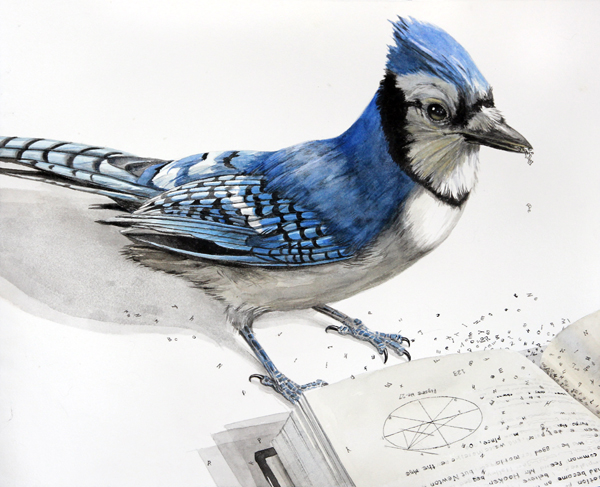
Front Room Gallery is proud to present a solo exhibition of new paintings and sculpture by Thomas Broadbent. In this new series of works the artist explores the idea of situational adaption of nature, with curious results. Broadbent often pairs commonly known birds with typical household objects, creating uncanny scenarios that seem familiar, but point to larger implications. Broabent's philosophical compositions often depict birds amongst mundane trappings of everyday humanity. These paintings, in a seemingly well-structured world of man-made artifice, reference the underlying impulses of nature.

Broadbent's large-scale watercolors have an absurdity to them that borders on the surreal, they are plausible scenarios, but the unlikely combination of elements, objects, and animals are otherworldly and common at the same time. Broadbent incorporates the style of James Audubon, representing birds and natural elements as life-size, with impeccable attention to detail.

Broadbent often juxtaposes these birds with objects in his stark picture plane that should be ten times bigger. Scale itself seems contorted in these new works; the viewer is suspended in a recalibration of realism, where a chickadee may seem gigantic in comparison to the ladder where it is perched, or the ladder itself appears miniaturized

Thomas Broadbent defines adaptation as a change in a plant or animal that makes it better able to live in a particular place or situation. His fascination with the way in which nature is endlessly able to adjust to a rapidly changing world, helps to inform his choice of elements in his compositions. His specifically limits his aviary subjects to birds that are reverenced in the famous: "Birds of America.” In this context Broadbent has selected volumes specific to his personal travels and objects relative to domesticity and construction in the United States. Environmental adaptation is personal as it is universal in the natural world; the quality of nature to adapt allows for preservation. The visualization of this adaptation can be surprising as it is fantastical and disquieting.

Broadbent has shown extensively throughout the U.S. as well as internationally. Broadbent’s numerous solo exhibitions include the Visual Art’s Center of New Jersey, Voorkhamer Gallery (Lier, Belgium), Croxhapox Gallery (Gent, Belgium) Inspace gallery (Beijing, China) and the Newark Arts Council. Broadbent’s work has been reviewed in The New York Times, The New Jersey Star-Ledger, NY Arts, The Brooklyn Rail and numerous other publications.

Thomas Broadbent "Adaptation" Exhibition Now On View


Broadbent

Thomas Broadbent

Adaptation

May 2nd-June 1st, 2014
Reception: Friday, May 2nd, 7-9Fri–Sun 1-6 & by appointment

Front Room Gallery is proud to present a solo exhibition of new paintings and sculpture by Thomas Broadbent. In this new series of works the artist explores the idea of situational adaption of nature, with curious results. Broadbent often pairs commonly known birds with typical household objects, creating uncanny scenarios that seem familiar, but point to larger implications. Broabent's philosophical compositions often depict birds amongst mundane trappings of everyday humanity. These paintings, in a seemingly well-structured world of man-made artifice, reference the underlying impulses of nature.

Broadbent's large-scale watercolors have an absurdity to them that borders on the surreal, they are plausible scenarios, but the unlikely combination of elements, objects, and animals are otherworldly and common at the same time. Broadbent incorporates the style of James Audubon, representing birds and natural elements as life-size, with impeccable attention to detail.

Broadbent often juxtaposes these birds with objects in his stark picture plane that should be ten times bigger. Scale itself seems contorted in these new works; the viewer is suspended in a recalibration of realism, where a chickadee may seem gigantic in comparison to the ladder where it is perched, or the ladder itself appears miniaturized

Thomas Broadbent defines adaptation as a change in a plant or animal that makes it better able to live in a particular place or situation. His fascination with the way in which nature is endlessly able to adjust to a rapidly changing world, helps to inform his choice of elements in his compositions. His specifically limits his aviary subjects to birds that are reverenced in the famous: "Birds of America.” In this context Broadbent has selected volumes specific to his personal travels and objects relative to domesticity and construction in the United States. Environmental adaptation is personal as it is universal in the natural world; the quality of nature to adapt allows for preservation. The visualization of this adaptation can be surprising as it is fantastical and disquieting.

Broadbent has shown extensively throughout the U.S. as well as internationally. Broadbent’s numerous solo exhibitions include the Visual Art’s Center of New Jersey, Croxhapox Gallery (Gent, Belgium) Inspace gallery (Beijing, China) and the Newark Arts Council. Broadbent’s work has been reviewed in The New York Times, The New Jersey Star-Ledger, NY Arts, The Brooklyn Rail and numerous other publications.

April Williamsburg Second Friday Event


Join us Friday, April 11th from 7-9PM for
Williamsburg Second Friday Event

Walker Pickering: "Nearly West"

on view through April 27th

Front Room Gallery is proud to present “Nearly West,” a solo
exhibition of photographs by Austin based artist Walker Pickering. In
this series Pickering reflects on the subtleties in the landscape and
culture from West Texas to the Southern regions of the US. Through
the lens of travel and adventure, he seeks out the hidden among the
ordinary. Pickering’s work captures the mundane trappings of
travel, rest-stops and unexpected roadside encounters.

The places immortalized in Pickering’s work often show the wear of
time, they seem to have gone unnoticed for years, they have their own
lives and feel like they might never change—or they might be gone
already. In one of Pickering’s photographs a forgotten
architectural feature, an ornate entryway to a no longer existing
building, with the word “Mayflower” carved into the stone stands
guard over an empty plot in a field. In another photo, “Business
Cards,” a dimly lit storage space in an office, business cards are
taped to the walls cover every available surface, a textural overload
that has built over decades.

Pickering’s photographs in this series almost never have people in
them but the human hand is always evident in the environment. In
“Hole” a bucolic landscape containing a verdant river flows from
the distance towards the viewer, the lush fauna is reflected in the
river, an altogether beautiful scene—but centered in the middle of
the square photo is a large, completely unexplainable, circular hole
in the river. While the hole in the river is obviously man-made it is
a mysterious presence in the photo, a vortex to another dimension.

This is Walker Pickering’s first solo exhibition at The Front Room,
Walker received his MFA in photography from Savannah College of Art
and Design, and currently teaches photography at the Art Institute of
Austin. 

Patricia Smith: Mapper Now on VIew


Front Room Gallery presents Mapper, an exhibition of new works on paper by Patricia Smith. Known for her idiosyncratic cartographic explorations of the psyche and mental states, Smith incorporates new outer and inner geographical regions in her latest works. 
The writings of the Situationists on psychogeographical mapping served as a jumping off point for her recent year-long odyssey to Paris and other European cities to create works incorporating some of the locations that inspired these concepts. In her wanderings (dérives) through unfamiliar places, the artist gathered impressions of physical space, the residue of history, related emotional states, synchronicities and other details to map a specific place, time and point of view. The finished works are delicate, highly detailed paintings on paper incorporating images and texts rendered in ink, pencil, watercolor, rubber stamping and collage. Smith’s faintly biomorphic forms are somewhat reminiscent of medical illustration, antique cartography and mystical diagrams, yet are something else entirely.

Smith’s mappings are not exclusively anchored in external geography. In other works, such as Schizoanalysis, she organizes and analyzes texts, and maps their intersections with her own thoughts. The results are a highly individual infiltration of mapping into the fluid and mysterious regions of the mind.

As critic Benjamin Sutton has stated, “Smith's mind maps underline how we make sense of our accelerated and dematerialized interactions in elaborate, self-reflexive spatial terms. Maps grow more important as our trajectories become increasingly unclear.”

Patricia Smith has exhibited widely in the US and internationally, including recent exhibitions at Broadcast Gallery in Dublin, Ireland, Housatonic Museum in Bridgeport, CT, Voorkamer in Lier, Belgium, Bob Rauschenberg Gallery in Fort Meyers, FL and other venues in Paris, New York, Los Angeles and Montreal. Her work has been reviewed in numerous publications, including The New York Times, Art in America, the LA Times and L Magazine. In 2013 she was awarded a six-month residency at Cité Internationale des Arts in Paris. This May she will be an artist in residence at Stichting Kaus Australis in Rotterdam. Smith lives and works in New York. 

take it EASE... at the Front Room


Take it EASE...

SONICfront

This Friday, February 21th from 7-9pm

An evening of performances exploring the theme of anxiety
Featuring:

Single Dribble and Natto, 
Brian Olin,
Lisa Levy,
John Mejias


Relax and relieve your anxieties with the satiric group Single Dribble and Natto - freeing your inner chi.

Dr. Lisa Levy, S.P. (Self-Proclaimed) performs psychotherapy on audience volunteers. But you don't just have to listen to Dr. Lisa, the audience has a chance to voice their opinions as well. Funny, real and often cathartic!

I'm Wurried is based on a collection of recordings compiled by Mejias in which his young students talk about their worst fears. Using classroom materials, such as cellophane and overhead projectors, performance visually narrates these anxieties. The reverse shadow puppet play illuminates common and uncommon fears as depicted by John Mejias.

"Constructing Abstraction" Curated by Melissa McCaig Welles and Kathleen Vance


January 10th - February 9th, 2014
Reception: Friday, January 10th, 7-10
Fri–Sun 1-6 & by appointment

The Front Room Gallery is pleased to present "Constructing Abstraction", featuring NYC based artists Peter Fox, R. Nicholas Kuszyk, Jesse Lambert, Mark Masyga, Chris Uphues, and Andrea Von Bujdoss. Curated by Melissa McCaig-Welles and Kathleen Vance.

“Constructing Abstraction” explores the intersection between studio practice vs. public works, figuration within abstraction and geometric construction with abstraction.

Artists in this exhibition build abstracted constructions of form, color and line; within each artist’s individual practice, there is an intersection of thematic references of figuration and abstraction. Chris Uphues creates definition out of abstraction; his optically full spherical compositions are articulated through the layering and accumulation of whimsical forms and figures in an isometric format.

Mark Masyga abstracts the physical, referencing structures found in construction sites: rubble, bricks and metal are transformed into geometric shapes and color fields. Masyga’s forms, geometrical and organic, build concrete definition from abstraction. R. Nicholas Kuszyk’s figuration is integrated into geometric constructions, his figures are capricious and fantastical, each working alongside one another in calculated fields infused by dense color and geometrical planes.

Jesse Lambert’s abstracted optical grounds are built of color washes that integrate linear fragmented figurations in dreamlike environments. Andrea Von Bujdoss depicts abstractions of prisms of light through the use of graphic compositions of isometric shapes and rays of vibrant colors. Peter Fox’s work optically mixes colors by building a physical construction of paint and accumulating layered pigmented lines of colored drips. Fox integrates chance with control, he combines geometry with the organic and creates figuration from the abstract.

Each artist employs the use of developed and sophisticated patterning and repetition to create their own internal language. These artists appropriate and develop their own iconography transmuted through abstraction. The distinct styles, each defined by their individual practices give clarity to their inspirations, whether informed from external references known only to themselves or self-referencing urban icons they themselves developed.

The exhibition will open with a reception on Friday, January 10, 2014, from 7-10pm and will run through February 9, 2014.


9PM Friday January 10th
Join us this Friday for January's 'sonic front'

featuring:

RADIO WONDERLAND & THE CYCLEBOX
HEIDI SABERTOOTH
TRABAJO

Each second Friday of the month Front Room Gallery presents sonic front, live performances by sound artists from around the world. sonic front is curated by Jeremy D. Slater in conjunction with Front Room Gallery that explores electro-acoustic improvisation, electronic music, and sound art.


"Mapping Heaven" Now on View


Mapping Heaven
curated by Linda Griggs

November 22nd - January 5th, 2014

Reception: Friday, December 13th, 7-9

Fri–Sun 1-6 & by appointment

Front Room Gallery is proud to present "Mapping Heaven" a group exhibition of artists who use diagramming and mapping methods to explore the unknowable. 

This show includes installation, sculpture, painting, large format video, and collage by Babette Allina, Sally Curcio, Allen Hansen, Dennis Hlynsky, Thomas Lyon Mills, Igor Molochevski, Lindsey Noble, Anne LaPrade Seuthe, Patricia Smith and Larry Walczak. 

The concept for this exhibition, curated by Linda Griggs, is inspired by "Darwin's God" by Robin Marantz Henig (March 4th, 2007, New York Times Magazine) which discussed Stephen Jay Gould's idea of religion as a spandrel in the evolutionary biology of the brain. 

A spandrel in architecture is the triangular space between the shoulders of two arches and the ceiling above it. Spandrels are a byproduct of the architect's intent to hold up a ceiling or dome with a colonnaded row. 

Within the theory of exaptation: spandrels are defined as characteristics that did not originate by the direct action of natural selection and that were later co-opted for a current use.

Stephen Jay Gould appropriated this architectural term to illustrate this theory, futher using ‘spandrels’ to describe religion as a byproduct of the evolutionary tools of agent detection, causal reasoning and theory of mind. Those who cherish religious belief need not be offended. Wouldn't "Intelligent Design" preprogram our brains to search for God. 

Gould's choice of an architectural term is poetic when viewing art that explores mapping and the diagram as a metaphor. As Thomas Lyon Mills, artist and educator, wrote,

"Like mapmakers, we draw and paint what we observe, but find our drawings inevitably cross over into the unknown, for, like maps, they are never truly, wholly accurate, never allowing for shifting points of view, or even the necessity of dreams. This then, is our region—where the visible and invisible meet, where the observed and the intuitive lie side by side, and where the seen pays a constant debt to the unseen"

There is a visual overlap in the appearance of diagramming and mapping even though one helps you understand something and the other helps you find someplace. But when the thing and place are unknowable, it's hardly a meaningful distinction. Artist Dennis Hlynsky notes that "One of the diagram’s most intriguing aspects is how it allows us to see a mind at work, thinking things out on paper, unconcerned about whether others will find that thinking coherent. Diagrams can easily leap time and space, bridging unlike ideas and giving form to otherwise impossible notions or invisible plots." 

“Mapping Heaven” presents works that give a physicality to the intangible concepts and thoughts that are held in the nethers of our minds, where the phenomena of creative and imaginative understanding flourishes. 

Featuring:

Babette Allina works at the juncture of science and art and has produced a vertigo inducing installation that references celestial navigation. Originally produced for the Ladd Observatory, "Signs of Life" is a film of the extreme tides on the Bay of Fundy projected onto racing boat sails.

Sally Curcio’s series, “Bubble” uses materials such as pins, beads, false eyelashes, etc. to create miniature worlds enclosed under acrylic bubbles. During this time of economic, political and environmental uncertainty this work offers a dream of a safe protected environment and a nostalgia for mythical or fairytale worlds of childhood. 

For Allen Hansen being involved with the American landscape tradition has led to using diagraming architecturally, a different type of landscape that has as its reference only abstract ideals. 

Dennis Hlynsky is an American artist making mesmerizing recordings of the flights, swarms and musters of urban wildlife as a means of imagining the bedlam of shambolic behavior. 

With unique permission to paint alone in the Roman catacombs, Thomas Lyon Mills examines the elasticity of time and the necessity of dreams: where the observed and the intuitive lie side by side and where the seen pays a constant debt to the unseen. 

Igor Molochevski's "Invisible Beast" is an interactive performance of subversive reverence in which vibrations created in an antique Buddhist prayer bowl are analyzed and displayed as a visualization of "String Theory" equations. 

Within her work Lindsey Nobel has "developed a drawing language based on the otherwise invisible connections between humans and machines, effectively manifesting the immense grid of energy that now exists between human, machine, and spiritual consciousness. Humans found, or perhaps even invented, that consciousness, and we are now mapping it with our newest technologies, technologies that weave us together and make the universe that much smaller – small enough to fit onto a painting or even a sheet of paper. 

Patricia Smith's mapping works are the result of an elaborate process of combining layers of text with spontaneous drawing and information transposed from city maps, in an attempt to give shape to the space within the mind and to poke fun at its distorted record-keeping of lived experience. Her large format painting on neoprene rubber, Night Vision, is a more abstract vision of archetypal forms embedded within the collective unconscious. 

The feature of maps that most resonates with LaPrade Seuthe is their capacity tomake distant things seem close, and to represent close things as distant. In star(dust) to star(dust)the night sky culled from google maps is the source image. And while stars are hundredsof millions of miles away, we still are able to see some aspect of them withour bare eyes, and even turn to their constellations as maps to chart ourlives. 

Larry Walczak's MOLEcule is a painting/collage combination on canvas. It illustrates a hypothetical diagram that overlaps elements of the scientific & spiritual worlds.